

Horses see the
real you
And sometimes, that gives us an opportunity to see ourselves differently.
What would it take to accept yourself in this very moment?
Perhaps that's a harder question to answer than it first appears.
Because so much of who we become is shaped by what we've learnt about being in relationship with others.
We learn when to speak and when to stay quiet. When to move closer and when to pull away. How to protect ourselves from rejection, disappointment or hurt.
And sometimes, we become so practiced at being who we think we need to be that we lose sight of who we are beneath it all.
These patterns don't simply disappear because we understand them.
Often, we need opportunities to experience something different.
Horses invite us into a relationship that doesn't rely on words. They respond to the world around them in ways that can help us become curious about our own responses, our boundaries, and the ways we approach connection.
There is no need to perform, to have the right answers, or to arrive knowing what you need.
Just an opportunity to slow down, notice what unfolds, and perhaps discover something about yourself that you hadn't quite seen before.
And sometimes, that's where change begins.

What is equine assisted psychotherapy?

Equine Assisted Psychotherapy (EAP) is an experiential form of psychological therapy that brings together evidence-informed psychological approaches and interactions with horses.
Unlike traditional talk therapy, where much of our work happens through conversation, EAP offers opportunities to explore our experiences as they unfold.
Because sometimes, the things we find difficult to put into words are the very things we notice most clearly in our bodies, our relationships, and the ways we respond to the world around us.
Horses are naturally responsive to their environment, to movement, and to the interactions taking place around them. Being in their presence can offer opportunities to become curious about our own responses, the space we take up, the boundaries we hold, and what happens when we move towards or away from connection.
Sessions are facilitated by Gabby, a Clinical Psychologist and Equine Assisted Psychotherapy Practitioner, drawing on her experience in trauma, attachment, and relational therapies.
There is no riding involved, and you don't need any previous experience with horses. Sometimes the most meaningful moments happen simply through observing, being present, or noticing what arises.
The intention isn't to change who you are, but to gently explore the ways you've learned to be in the world, and what might become possible when you have room to respond differently.
Gabby’s Approach: More Than Words
As a Clinical Psychologist and Equine Assisted Psychotherapy Practitioner, my approach brings together an understanding of trauma, attachment, the nervous system, and the ways our earliest relationships can shape how we experience ourselves and others.
I'm trained in the Equine Psychotherapy Institute (EPI) Model, an integrative approach that draws on psychotherapy, attachment theory, somatic awareness, mindfulness and the relational experiences that can emerge when working alongside horses.
And perhaps what matters most isn't the model itself. It's how we use the experience to better understand you.
Our work together isn't about teaching you to be calmer, more confident, or less sensitive. Nor is it about asking you to change the parts of yourself that have helped you navigate difficult experiences.
Instead, we begin with curiosity.
We might notice what happens when a horse moves towards you, or when it chooses to move away. What it feels like to set a boundary, to ask for something, or to sit with uncertainty. We might explore the urge to please, to withdraw, to take responsibility, or to anticipate what might happen next.
Not because a horse's behaviour tells us something definitive about you, but because your experience of the interaction may offer something meaningful to explore.
There is no right way to respond, and nothing you need to get right.
Together, we make space for what emerges, bringing understanding and compassion to the ways you've learned to move through the world.
And perhaps, over time, discover that there are other ways of being, too.
“The ways we learn to protect ourselves often begin long before we understand why we need them. Healing isn’t about getting rid of those parts of ourselves. It’s about creating the space to discover that we may no longer need to rely on them in quite the same way.”

Regulate. Relate. Reason.
Our nervous systems are constantly responding to the world around us.
Long before we consciously make sense of an experience, we may notice something shifting in our bodies. A tightening in the chest. An urge to move away. The feeling of needing to do something, say something, or make things right.
These responses are not random. They are often shaped by what we've experienced, what we've learnt to anticipate, and the ways we've adapted to feel safe.
Within Equine Assisted Psychotherapy, we may explore three interconnected experiences:
Regulate: Learning to notice and respond to what happens within us.
Rather than trying to eliminate uncomfortable feelings, we begin to develop an awareness of our nervous system, recognising when we're becoming overwhelmed, disconnected, or unsettled, and exploring what helps us feel more grounded and supported.
Relate: Exploring how we experience connection.
Our interactions with horses can offer opportunities to notice how we approach relationships, respond to boundaries, navigate uncertainty, and experience closeness or distance.
These moments can become invitations to explore the relational patterns we've learned, with curiosity rather than judgement.
Reason: Making meaning of our experiences.
Together, we can begin to make sense of what we've noticed, connecting these experiences with our understanding of ourselves, our relationships, and the ways we've learned to navigate the world.
These aren't three steps we need to move through in a particular order.
Sometimes we find understanding through connection. Sometimes greater awareness helps us feel more settled. And sometimes, an experience offers something meaningful long before we have the words to explain it.
There is room for all of it.
Meet the therapy herd
Nestled in the Perth Hills, sessions take place on my private property in Mount Helena, surrounded by open paddocks, fresh air, and the gentle rhythm of life with horses.
Here, you'll meet Peanut and Troy.
Peanut is our beautiful chestnut Thoroughbred, whose slower pace and gentle nature remind us that there's no need to hurry. Sometimes, simply being alongside another living being is enough.
Troy is the newest member of our herd. A tall, experienced Thoroughbred with a history in eventing, he's now enjoying a quieter chapter of life. He's still finding his place here, and we're looking forward to getting to know him in this new role.
Every horse has their own personality, preferences and boundaries. They aren't trained to respond to us in a particular way, and that's part of what makes working alongside them so interesting.
There are no expectations to ride, lead, or even touch the horses.
Sometimes we interact. Sometimes we observe. And sometimes, we simply share the same space.
Whatever unfolds, we approach it with curiosity, respect, and an understanding that both people and horses deserve the freedom to be themselves.
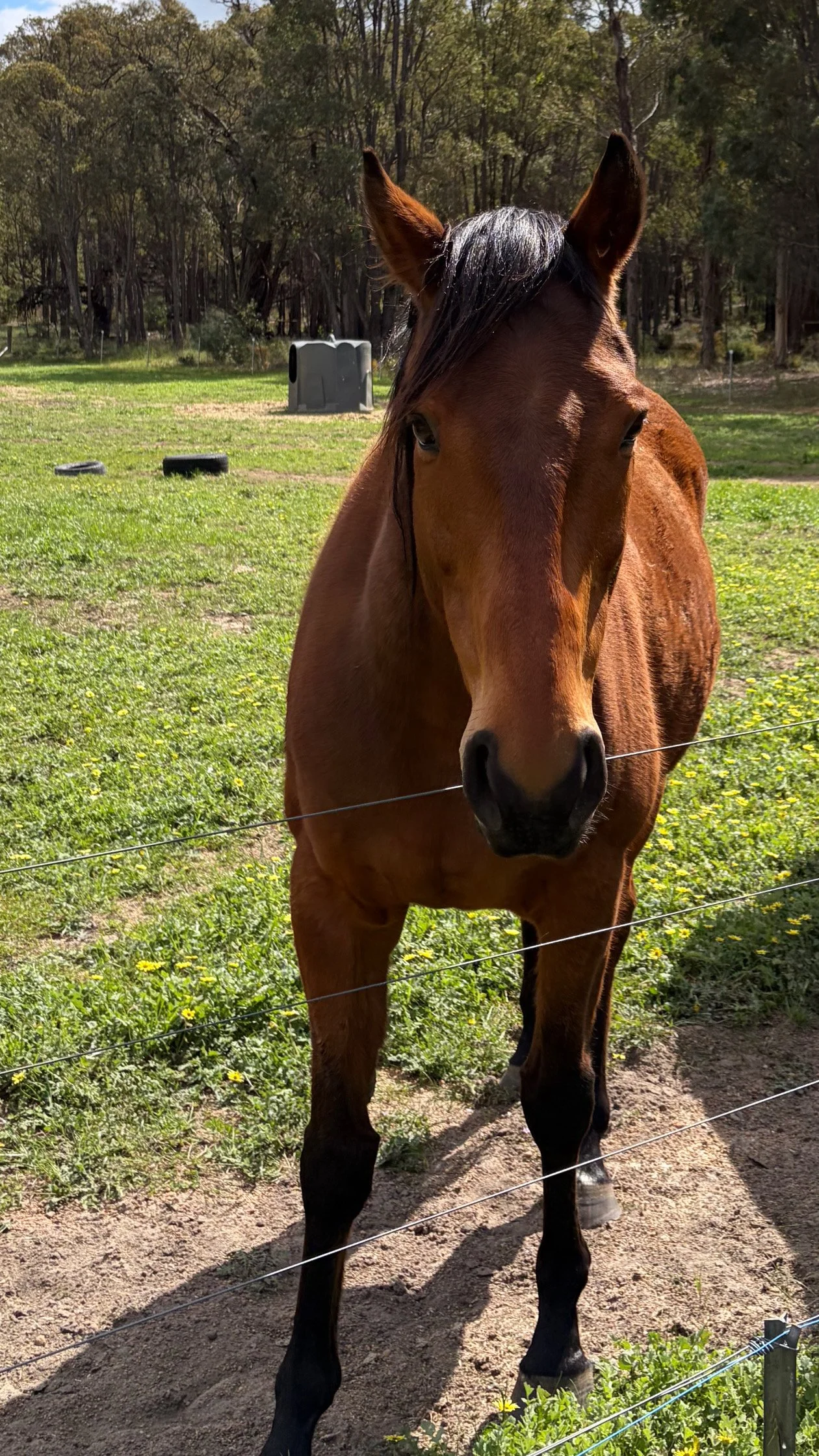
A little piece of our history, and forever part of our hearts.
Before Troy joined us, there was Richie.
Richie was a much-loved member of our herd, and an important part of the work we shared with the people who came here.
We lost him unexpectedly in September 2026, and his absence is still deeply felt.
Some horses leave their hoofprints on the ground. Others leave them somewhere much deeper.
Richie did both.
And while he is no longer here to greet the people who walk through our gates, he will always be part of our story.
A different way to begin.
You don't need to know exactly what you're looking for, or have the words to explain what you've been carrying.
Sometimes, curiosity is enough.
Whether you're beginning therapy for the first time, returning after some time away, or looking for a different way to explore your experiences, you're welcome here.
Equine Assisted Psychotherapy sessions are currently available on Tuesdays at my private property in Mount Helena, in the Perth Hills.
I'd be honoured to share this space with you.
FAQs
-
Sessions typically run for 60–75 minutes and take place at my private property in Mount Helena, in the Perth Hills.
Depending on your individual needs, sessions may take place in the paddocks, alongside the horses, or in my consulting room. We may also move between these spaces throughout a session.
There is no expectation to spend the entire session interacting with the horses. Our time together is guided by what feels appropriate and therapeutically meaningful for you.
-
Equine Assisted Psychotherapy sessions are $350 for 60–75 minutes.
Medicare rebates may be available for eligible psychological consultations where the relevant Medicare requirements are met. Private health insurance rebates may also be available, depending on your level of cover and your insurer's requirements.
We also offer a seven-week Horse Wisdom Programme for those interested in a more structured therapeutic experience. Please contact our practice team for further information about the programme and its fees.
If you're unsure about fees, rebates or booking options, you're welcome to contact us at hello@thesagesociety.co.
-
Yes. We welcome clients who are self-managing their NDIS funding, where Equine Assisted Psychotherapy is an appropriate and eligible support under their plan.
Sessions are provided by Gabby, a registered Clinical Psychologist, and are individually tailored to the client's therapeutic needs and disability-related goals.
Please note that NDIS funding cannot be used for every form of equine therapy or psychological treatment. Eligibility depends on the nature of the service, the participant's individual plan and the applicable NDIS requirements.
Our standard EAP fee is $350 for 60–75 minutes. Fees and funding arrangements will be discussed before booking, and participants are responsible for ensuring the service is eligible under their NDIS plan.
For enquiries, please contact hello@thesagesociety.co.
-
Yes. Depending on your individual needs and therapeutic goals, Equine Assisted Psychotherapy can be incorporated alongside EMDR therapy.
EMDR helps us process distressing experiences and the beliefs, emotions and physical responses associated with them. EAP offers opportunities to explore some of these responses in the present moment, particularly in relation to connection, boundaries, safety and trust.
For some clients, these approaches can compliment one another, allowing us to bring together the understanding developed through EMDR with experiences explored alongside the horses.
This doesn't mean every client will need or benefit from both approaches. We'll consider your history, current needs and treatment goals together, and develop an individualised plan that feels appropriate for you.
Where suitable, more intensive treatment options may also be discussed.
-
All Equine Assisted Psychotherapy sessions are facilitated by me, Gabby, a Clinical Psychologist and qualified Equine Assisted Psychotherapy Practitioner.
You'll also have the opportunity to spend time alongside Peanut and Troy, our two beautiful Thoroughbreds, each with their own personalities, preferences and ways of interacting with the world.
Sessions are individually tailored to your therapeutic needs, and we'll work together at a pace that feels appropriate for you.
If you'd like to learn more about my qualifications, experience and therapeutic approach, you're welcome to visit the About page.
-
Not at all. You don't need any previous experience with horses to participate in Equine Assisted Psychotherapy.
It's completely understandable to feel a little uncertain around horses, particularly if you haven't spent much time with them before.
We'll move at a pace that feels appropriate for you, with your comfort, preferences and safety guiding how we approach interactions.
There's no riding involved, and no expectation that you need to touch, lead or handle a horse. Sometimes our work involves interacting with them, and sometimes it simply involves observing or spending time in their presence.
You don't need to know anything about horses to begin.
-
Yes, in some circumstances, it may be possible to incorporate your own horse into our therapeutic work.
For equestrians, the relationship we share with our horses can offer meaningful opportunities to explore trust, confidence, boundaries, communication and the ways we respond to uncertainty.
Whether you're navigating riding-related anxiety, rebuilding confidence following a difficult experience, or simply wanting to better understand your relationship with your horse, this may be something we can explore together.
All arrangements are considered individually, taking into account your therapeutic goals, the suitability and welfare of your horse, and the practical and safety requirements of bringing them onto the property.
Please contact our practice team at hello@thesagesociety.co to discuss whether this option may be suitable for you.
-
Alongside individual Equine Assisted Psychotherapy sessions, I occasionally explore opportunities for more immersive, individually tailored therapeutic experiences.
These may include extended sessions or structured programmes, depending on individual needs and availability.
If you're interested in exploring a more intensive approach, please contact our practice team at hello@thesagesociety.co to discuss what's currently available.
-
Yes. As both a Clinical Psychologist and horse owner, I understand that our relationships with horses can be deeply meaningful, and sometimes complicated.
I also offer psychological support for equestrians experiencing riding-related anxiety, difficulties with confidence, or the emotional impact of an accident or challenging experience.
Depending on your needs, this work may incorporate EMDR, psychological strategies and equine-assisted experiences.
Please contact our practice team to discuss whether this approach may be suitable for you.
-
Of course. We understand that beginning something unfamiliar can bring up questions, and you're always welcome to ask.
Whether you'd like to know more about what sessions involve, discuss whether EAP might be suitable for you, or simply clarify something before booking, our practice team is happy to help.
You can reach us at hello@thesagesociety.co.